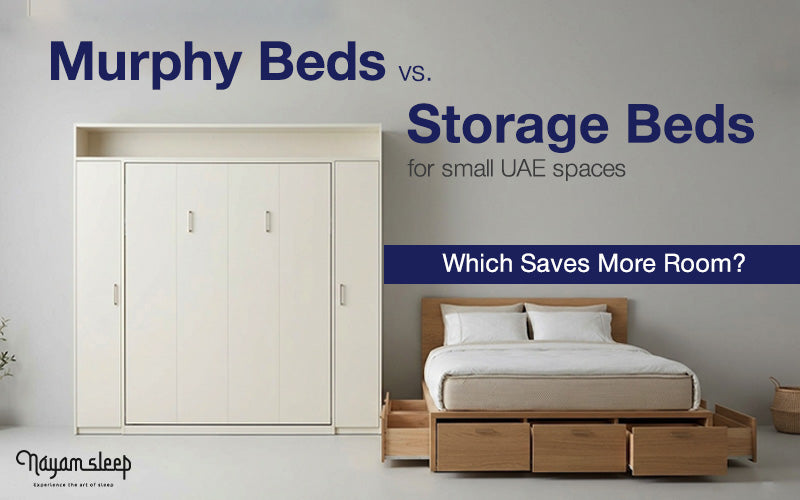
Murphy Bed vs Storage Bed: Which Actually Saves More Space in UAE Apartments?
Living in a compact apartment in the UAE constantly negotiates your limited space. A bed takes up the biggest chunk of it. The question is simple: do you want that space back during the day? If not, do you want to hide your clutter inside it?
Key Takeaways
- Murphy beds recover ~27 sq ft daily while storage beds save zero floor space.
- Storage beds offer 30–50 sq ft hidden storage. They reduce your need for furniture.
- Murphy suits multi-use rooms. Storage suits are better for clutter-heavy households.
- Murphy needs installation, while storage beds are easy to assemble and move.
Why This Comparison Even Matters in the UAE
Most apartments in cities like Dubai fall into predictable size ranges, from 350 sq ft to 900 sq ft.
Now take a standard queen bed. It eats up around 37 sq ft of floor space. In a 400 sq ft studio, that’s almost 10% of your entire home. That’s not small. That’s annoying every single day.
So, more than just figuring out which bed is better, the real decision is: how do you want to use your space when you’re not sleeping?
How Murphy Beds Work (And Why They Feel Like Magic)
A Murphy bed, or a wall bed, folds vertically into a wall cabinet. When closed, it sticks out only about 16 inches. When open, it's a full bed, around 84 inches long.
That means:
- Open footprint: ~37 sq ft
- Closed footprint: ~10 sq ft
- Usable floor recovered: ~27 sq ft
That’s the space you can walk on. As a result, you can literally turn your bedroom into a workspace, do yoga, or simply add some bean bags to make it work like a lounge area. There’s a catch! You will have to fold it every day. Although folding the bed takes only about 2–5 minutes, there will be days when you may not feel like doing it, but you still have to!
How Storage Beds Work
Storage Beds also called Divan Beds don’t move. They stay exactly where they are.
What changes is what’s inside them. The mattress lifts (usually hydraulic), revealing a storage cavity about 12–18 inches deep. The typical capacity is 30–50 cubic feet of storage. That’s enough for storing extra bedding, seasonal clothes, a suitcase, and other random things you do not use frequently.
So while you don’t gain floor space, you reduce the need for storage cabinets. This indirectly saves space elsewhere.
The Real Difference: Floor Space vs. Hidden Storage
A Murphy bed gives you space back every day, while a storage bed helps you hide your stuff. While both beds offer alternatives, buyers often confuse them and regret their buying decision. So, if your problem is:
- “I have no room to move” → Murphy wins
- “I have too much stuff” → Storage wins
Installation Reality
Murphy beds are not plug-and-play. So, they require considerable effort for wall mounting. You’ll need about 81–88 inches of height clearance and a concrete wall. There can be extra charges for professional installation, approximately AED 500–1,000.
If you’re renting, this matters, as some landlords won’t allow drilling and some walls are drywall, making it risky.
On the other hand, storage beds can be assembled in 30-60 minutes with no wall damage. They are also easy to move when you shift apartments.
Cost Comparison in the UAE Market
You’ll find both options widely available. Storage beds, at Nayam Sleep, usually start at AED 2,000, going up to AED 20,000, depending on the style and size. Each bed features a smooth lift system, reducing the need for any kind of heavy lifting.
Murphy beds, on the other hand, range from AED 3,000 to AED 20,000. They can be custom-built and will require installation. Although Murphy beds are more expensive upfront, they can last long, 20+ years if maintained properly (gas pistons do the main task). Storage beds, on the other hand, are cheaper and easier to resell, too.
So, Which One Saves More Space?
Strictly speaking, the Murphy bed wins. After all, it frees ~27 sq ft daily. That's a usable, visible, walkable space. Storage beds, on the other hand, don’t reduce footprint. They just optimize what’s already there.
Here’s a quick check list to help you decide:
Choose a Murphy bed if you:
- Live in a studio (under 500 sq ft)
- Need multi-purpose space
- Work from home
- Don’t have excessive storage needs
Choose a storage bed if you:
- Have considerable things to store
- Have a fixed room layout
- Move your apartments often
- Want to avoid the hassle of installation and maintaining
Nayam Sleep’s collection of British-designed storage beds gives you the best of functionality and aesthetics. You can choose from a large variety of single, double, and kids' beds. You can also customize the size of your bed and add safety side railings. What’s more? You don’t have to compromise on your fabric either. There are about 25 options to pick from.
Upgrade your bedroom space with Nayam Sleep’s functional storage beds!
FAQs
What are some shortcomings of a Murphy bed?
A Murphy bed needs daily folding, costs more, and requires wall installation. So, it's not ideal for renters. Plus, low-quality hardware can wear out over time.
Can I sleep on a Murphy bed every night?
Yes, you can. It feels just like a normal bed. However, make sure your bed is properly installed and supported.
Which is better, a Murphy bed or a wall bed?
A Murphy bed is just another name for a wall bed. There is no difference in function or use.
What are the disadvantages of storage beds?
Storage beds save no floor space. As a result, your room may always feel full. It can also be heavy to lift and hard to move during shifting, depending on its build.
